



If you have ever suffered from anxiety or panic attacks, chances are you’ll understand this excerpt. But taking a look at anxiety in a different way can help us begin to understand why we sometimes feel like we do and may be the first step in improving your quality of life and feeling better each day. If you suffer from anxiety, there is something you should know which is often skipped over – ITS ONLY HUMAN to feel anxious … some of the time. Without anxiety to stop us taking unreasonable risks, the human race would have become extinct a long time ago.
However, too much anxiety can impact negatively on our lives and emotions and that’s usually where we feel out of control, where we suffer panic attacks or where we can’t seem to find a way to keep our personal boat stable as we navigate through life.
So maybe its time to take a different look at anxiety?
Anxiety is a natural survival mechanism, but if it gets out of control we can feel like its impossible to makes sense of our feelings or our actions. We may feel sick; dizzy or faint. We may find it impossible to fathom the reason for our stress response. We may struggle to take a breath or feel as if we are choking. All of these things simply add to our stress levels and pretty soon we feel overwhelmed and unable to cope.
You may be prone to anxiety for a number of reasons, trauma, thinking styles, lack of sleep, even a good imagination. You may suffer from all or only some of the ‘usual’ symptoms – but what really matters is that you are suffering from a degree of anxiety that is affecting your life negatively.
To begin to understand anxiety – we need to understand stress. Stress is created by an accumulation of pressure – physical or psychological – real or imagined. We are all unique and we all have different triggers so what stresses one person will be very different from what stresses another and that’s OK. When we become stressed, we immediately switch on our sympathetic nervous system – our fight-or-flight response- and learning to understand and control this response can play a huge part in helping you handle your reaction to stress.
Before you start to think ‘Hah! Imagined! So it’s me then! I should be able to control this!’ STOP. Take a breath and read on…
What happens when you have a panic attack ?
‘If you suffer panic attacks, you’ll know how frightening they can be. Feeling like you cant breathe, feeling sick or as if you are choking – these sensations are not imaginary. When we become stressed our breathing quickens and we take in extra oxygen which (because we are rarely actually running or fighting) we are unable to use, so we breathe it out in short shallow breaths.
This breath is really significant.
Oxygen needs carbon dioxide to do its job. Without it, oxygen molecules stick too closely to our red blood cells and it can’t be released into the various tissues of our bodies – so it can’t be absorbed by the cells which need it. Normally we breathe in the right amount of oxygen and with the help of carbon dioxide it gets delivered to our tissues and then the carbon dioxide is breathed out. BUT when oxygen is breathed out straight away the result of hyperventilation means that precious carbon dioxide is taken with it before it has done its job. Without carbon dioxide to help, the remaining oxygen sticks to the red blood cells and we feel oxygen starved even though we are taking enough in. Naturally people will start to gasp or pant to try and take more air in which has the opposite effect. The sensations of chocking or smothering then are real, but neither will actually happen. In truth you will not suffocate – the worst that might occur is that you faint and your breathing returns to normal, it is the fear and panic that cause the sensations you feel.
Fear Of Losing Control
Fear of losing control is a realistic reaction. You have switched on your fight-or-flight response to escape from danger but you don’t seem to be going anywhere. Your whole body is screaming at you to run or fight but you are doing neither – of course it feels like you are losing control. This is a feeling, not reality.’
The sense of being unreal which people often experience is a natural defence mechanism in these circumstances too. Your body is trying to lower your soaring arousal and calm you down. If you have a panic attack whilst say doing a weekly shop at Tescos and feel you have no choice but to abandon the trolley and leave does that mean you lost control? Did you leave by the door or try to dig your way through the floor where you stood with a fish slice? If you left by the door you didn’t lose control. You simply did the only thing that you knew may lower your panic.
How can controlling your breath help?
Many of the effects of a panic attack are caused by hyperventilation. If you were to breathe noisily through your mouth for two minutes with short shallow breaths you would experience similar symptoms.
There are a few things you can begin to work on which can help bring your breath back to normal and begin to switch on your parasympathetic nervous system (rest-and-digest response) rather than your sympathetic nervous system (fight-or-flight). First of all, when you breathe through your mouth you lose much more carbon dioxide then breathing through your nose – so try the yoga approach of inhaling and exhaling through your nose.
When your exhale is even a few counts longer than your inhale, the vagus nerve (running from the neck down through the diaphragm) sends a signal to your brain to turn up your parasympathetic nervous system and turn down your sympathetic nervous system. Try to allow your exhale to be longer than your inhale, this can be done by counting – eg inhale for 3; exhale for 5; or you can find a mantra. This really isn’t as silly as you may think. Your mantra for example may be ‘ I can control this (inhale); I am calm and I am relaxed (exhale). The second sentence is slightly longer than the first so as you inhale you are re-affirming your ability to control your breath and in the second (exhale) affirming your ability to calm and relax whilst allowing a longer exhale to let your brain know all is well. The Sanskrit mantra So Hum is similar. When your brain knows you are not under threat your sympathetic nervous system will give way to your parasympathetic nervous system returning your mind and body to a less aroused state.
Why do I Panic?
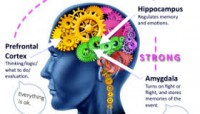
‘As our fight-or-flight response engages, we send chemicals like cortisol and adrenalin rushing into our blood stream; our muscles tense (that’s our body getting ready to take action); we breathe faster perhaps making our chest tight or making our bodies shake (that’s to speed up the time it takes oxygen to get into our blood); our mouths may dry up (our digestion is interrupted, our kidney and intestine functions stop, diverting as much blood to our limbs as necessary to help us move) and we may sweat to try and cool ourselves down.’
All of these things are defence mechanisms which have served us well for millions of years. The trouble is the part of our brain that deals with deciding when we use these responses can’t tell the difference between our running away from a dinosaur; becoming stressed because a neighbour has picked and argument with us, or the dog just eaten tomorrows roast! Even worse, it cant tell the difference between events that it perceives as threatening and those that actually are life threatening.
In real terms, the ‘thinking’ part of our brain known as the neocortex is pretty new. Before it developed enough to allow us to analyse and imagine, we relied much more on this primitive brain which is still largely concerned with instinctive responses involving emotions – namely our fight-or –flight response.
This emotional brain contains the amygdala – which is small but really powerful and acts as our bodies alarm system. With access to our store of emotional memories and learned responses its job is to match new events to patterns in its store and judge whether we might be at risk. But because it needs to make decisions pretty quickly this pattern matching is pretty basic. It doesn’t have the sophistication of the neocortex so it operates in black and white and can’t introduce the shades of grey that exist in todays world.
When the amygdala decides we are under threat – it sends chemical signals instigating the fight-or-flight response without waiting till our ‘thinking’ brain can join the discussion. We have already begun to experience our pounding heart or shaking legs by the time we recognise the loud bang is, in fact a car backfire not an explosion. It’s important to understand that when the amygdala is in full flow trying to save our skins, it is so powerful that it can shut down our higher intelligence completely.
‘In true life or death situations we don’t want a highly intelligent system that will carry out reasoned analysis . We want an excitable (therefore stupid) system that can terrify us and make us dodge the bike and run for it before we even know what we are doing..’
Often this primitive brain may be wrong, so we may react and feel pretty embarrassed, but our primitive brain doesn’t care. It’s too busy saving our lives to care and it knows that embarrassment whilst uncomfortable won’t kill us.
When you become stressed one of the chemicals that is released into your system is cortisol and cortisol also prevents an area of the brain called the hippocampus from being able to communicate with your amygdala. Normally it creates a narrative for an event, giving it context and coding it in a way that it can be stored in the neocortex. Without the help of these more intelligent parts of the brain the poor old amygdala has to cope on its own and codes the situation that stresses you as a terrifying occurrence to be avoided at all costs. This example from ‘How to master anxiety’ by Joe Griffin & Ivan Tyrell shows how the amygdala will code your experience.
‘The light aircraft in which I was a passenger developed engine failure and we crashed into trees.
If the smell of fuel was strong when the aircraft crashed, the smell of petrol at an ordinary petrol station while filling up your car, could be sufficient to trigger feelings of absolute terror.’
Most people could begin understand the above but if when you were in a state of high arousal and there was a passenger in front of you wearing a pale yellow shirt – your amygdala may well note this and the same extreme feeling of terror could arise if you see the same colour shirt whilst riding the train or bus, or even doing the weekly shop – when you have had a big fright the amygdala makes matches all over the place!
How Do I Learn to Cope?
There are many types of therapy available to those suffering anxiety or panic attacks, here we simply hope to give a little insight into how and why anxiety affects us the way it does. Often simply understanding what is happening within our bodies gives us more confidence in dealing with everyday situations in a less stressful way.
Learn to relax
One of the most important things you can do to help you cope with anxiety and stress is to learn a reliable and pleasant way to relax. Yes – to do the one thing that you probably find hardest to do. But the ability to take time out, calm down, relax – whatever you want to call it – is one of the best weapons you have in coping with anxiety and stress and in regaining the balance needed to enjoy life to the full.
Often when we are asked to relax (or meditate for example), we feel it is impossible. The thought that we have to allow our overactive, over stimulated and often exhausted minds to become blank seems absurd – and it is. If it were that simple you could simply be hit over the head with a stick. Blank mind – job done.
Relaxation and meditation are not in fact about allowing our minds to become blank. They are about finding some space where we can focus on the present moment without the myriad of thoughts and worries that usually fill our heads. They are about finding a little peace. What you choose to do to find your own personal head space is unique to you. For some of us running gives us the space our brains need to switch off, for others yoga brings not only physical but mental focus and relief, for you it may be cooking – the truth is there is something out there that will work for you, but you need to make the time to find it.
Learn Some Basic Breathing Techniques
The following technique known as Nadi Shodhana is a basic yoga pranayama (breathing technique) that is regularly taught in health clinics and therapy sessions to help quiet the mind. It is particularly helpful to ease racing thoughts if you are experiencing anxiety, stress, or having trouble falling asleep. There are several different styles of Nadi Shodhana, but they all serve the purpose of creating balance and regulating the flow of air through your nasal passages.
In addition to calming the mind and relieving stress, alternate nostril breathing also: Improves our ability to focus the mind; Supports our lungs and respiratory functions: Restores balance in the left and right hemispheres of the brain: Rejuvenates the nervous system: Removes toxins & settles stress.
Try practising this breathing technique daily, the more comfortable you are in the practice the more easily and quickly you will feel the benefits when you bring it into play when stress arises.
- Take a comfortable and tall seat, making sure your spine is straight and your heart is open.
- Relax your left palm comfortably into your lap and bring your right hand just in front of your face.
- With your right hand, bring your index finger and middle finger to rest between your eyebrows, lightly using them as an anchor. The fingers we’ll be actively using are the thumb and ring finger.
- Close your eyes and take a deep breath in and out through your nose.
- Close your right nostril with your right thumb. Inhale through the left nostril slowly and steadily. Take 5 rounds of breath through your right nostril. Imagine gently breathing in and out through your navel without forcing. Relax your shoulders and feel your rib cage expand as you inhale slowly. It is important the breath is not forced.
- After five breaths release your right thumb opening the right nostril and close the left nostril with your ring finger.
- Repeat the breathing technique on the left side for 5 rounds of breath before releasing left nostril and returning thumb to right nostril
- Repeat 5-10 cycles, allowing your mind to follow your inhales and exhales.
- After your chosen number of breaths with eyes still close allow both hands to rest on thighs or knees and allow 5 gentle rounds of breath through both nostrils.
- Allow eyes to come slowly to open as you exhale
Consistency is helpful, so try to match the length of your inhales, pauses, and exhales. For example, you can start to inhale for a count of five, exhale for five, You can slowly increase your count as you refine your practice.
Practice mindfulness
It is true to say that those who suffer from anxiety have a tendency not to spend much time ‘in the moment’. Rather than becoming absorbed in a task, they are more likely to do things absentmindedly while allowing their mind to focus on the past or future. Mindfulness seeks to allow our minds to focus on the present moment. Whilst it takes a little time to learn it’s really worth the effort.
Imagine finding a way to switch off the voice in your head which constantly bombards you with ‘what if’ scenarios until you feel you have chased a single thought down a million terrifying rabbit holes and are quite simply exhausted? Mindfulness can give you a tool to quieten that voice and allow you to focus on what is really important – now.
Try this simple exercise for yourself.
Decide to give yourself a simple task with which you are familiar and comfortable. This could be cleaning the car; doing the garden or even washing the dishes. Here is an example:
Make yourself a cup of herbal tea. (Best to avoid coffee or stimulants if you can) Pick the kettle up – notice its weight. Be aware of all the movements you make as you lift it, notice every movement as you move to the sink and fill the kettle. Notice as you turn the tap, notice the sound of the water, notice the muscles in your arms as the kettle becomes heavier. One after the other notice all the movements you make as you make them. As the water heats notice as you find the tea, put the bag in the cup, notice all these things. Let your focus be entirely on the activity you are engaged in and on what you are seeing and sensing but don’t THINK about making a cup of coffee. Your aim is to experience , not to actively think or make judgements. Once the tea is made notice the smell, the taste, the heat, even the weight of the cup. Notice how your mouth feels when you drink. If thoughts intrude (you are normal) just be aware you are having that thought, let it go and gently guide yourself back to the task in hand. Taking little periods of mindfulness practice can give a welcome break from the thoughts that lead to the arousal of stress.
Don’t be hard on yourself when you start to learn this practice. When you notice that your mind has wandered you have in fact made a breakthrough – before you would simply have followed your mind down the rabbit hole, now you recognise and are drawing it back. Well done!
So mindfulness then, is in part about giving what Buddhists call the ‘monkey mind’ something to focus on. Our monkey mind is busy, lively and excitable. It loves chaos! It jumps from pillar to post, not wanting to rest and it doesn’t want us to either – but sometimes we need a break. So like an unruly child we control it by offering it something to focus on.
There are many mindfulness classes available throughout the UK. From personal experience Yoga is a great way of learning mindfulness. It teaches us to become aware (notice) the ebb and flow of both mind and body in each moment. It teaches us that how we hold our body affects our mind and our emotions and through practice we learn to release that which no longer serves us and we find a single pointed focus in our practice. As one of my students announced, ‘I forget about my stress when I am on the mat – it’s too hard to focus on it in a complicated balance’ Its true- your brain will focus on the moment!
The key thing to remember is that it doesn’t really matter what the task you choose to ficus on it – what matters is your attention to it.
There are many ways of coping with anxiety and stress and many ways of finding your own most effective ways to navigate lifes ups and downs, but there is only one starting point.
To take that first step and to know that you are not alone.

Excerpts : ‘How to master anxiety’ by Joe Griffin & Ivan Tyrell

